Princess Leia: A Heroine Who Redefined Gender Roles
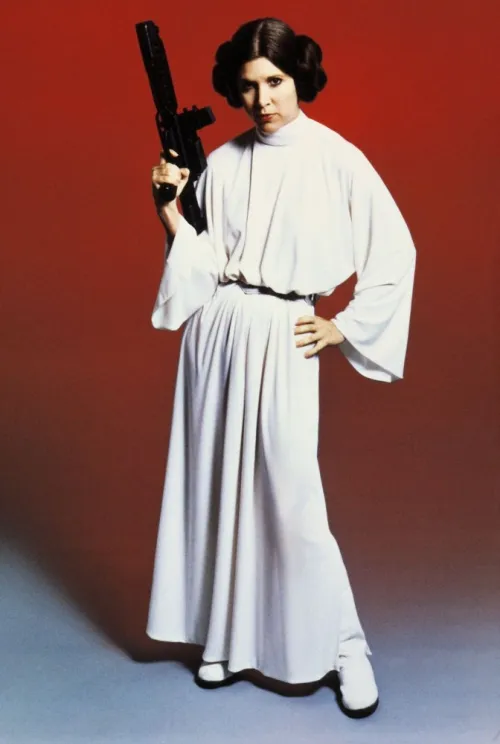
She is tortured by Darth Vader—but does she reveal the location of the Rebel Base to betray her people and, in return, free herself? Never. She remains a defiant warrior until the end. Meet the heroine who destroys the traditional structure of gender roles in society: Princess Leia Organa of Alderaan, portrayed by none other than Carrie Fisher.
Princess Leia was not only a member of the Imperial Senate, but also a diplomat and a spy for the Rebel Alliance. When Star Wars: Episode IV – A New Hope was released in 1977, it transformed Carrie Fisher into an iconic goddess, largely due to the strength and complexity of Leia’s character.
In Episodes IV, V, and VI, Leia is rescued multiple times—but never passively. Every mission to “save” her is met with Leia’s sharp intellect, unflinching leadership, and unwavering independence. Rather than fitting the classic Damsel in Distress trope, Leia redefines it, asserting power and autonomy even as she is rescued. Who else would dare say to their rescuer: “I don’t know who you are or where you came from, but from now on you’ll do as I tell you, okay?”
Leia’s “rescues” are more like equal partnerships than helpless victim scenarios. Her assertiveness, courage, and refusal to be sidelined are central to her role in the original trilogy. But if Leia is so widely celebrated for embodying masculine-coded leadership, why does her near-nude golden costume in Return of the Jedi remain one of the most iconic visual associations with her character?
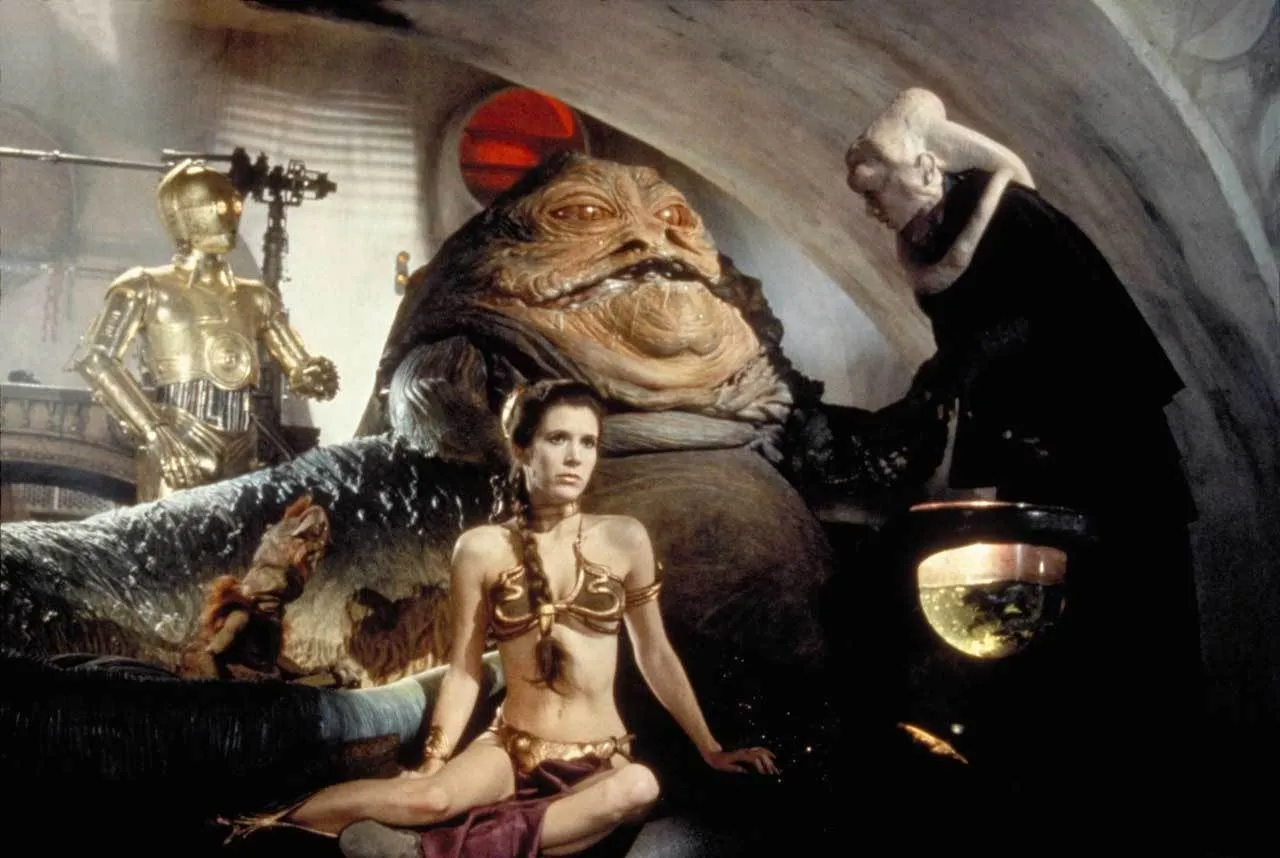
In this infamous scene, Leia is imprisoned by Jabba the Hutt and forced to wear a revealing golden slave costume. She is chained and completely restricted—her body objectified and her agency visibly stripped away. This moment casts Leia back into the traditional role of Damsel in Distress, effectively undoing the powerful image built in the previous films.
How can one remember Leia’s leadership, diplomacy, or political standing when she is reduced to a sexualized, enslaved spectacle? The visual impact of this costume has, for many, overshadowed the very qualities that made Leia revolutionary. It’s a reminder of how female characters, no matter how empowered, are often still at risk of being undermined by the male gaze.
Princess Leia and the Feminine Discourse: A Luce Irigaray Perspective
French feminist philosopher Luce Irigaray critiques societal gender roles by distinguishing between masculine and feminine discourse. She calls for the demolition of this long-standing “theoretical machinery” that has governed social norms for centuries.
In a typical fairytale, the character of the Damsel in Distress is the embodiment of feminine discourse: passive, waiting, and dependent. She sits in a tower, awaiting rescue. The male hero, representing masculine discourse, is the one who takes action, saves the day, and reinforces power dynamics.
These traditional roles prescribe clear expectations for behavior and identity: men must be strong and courageous; women are to be weak and helpless. This binary setup not only limits identity but establishes a hierarchy of character value.
Irigaray identifies three socially accepted roles for women: virgin, mother, and whore. These labels, she argues, have for centuries defined the full scope of women’s value. Any woman who dares exist outside these categories—by showcasing masculine traits like autonomy or authority—is deemed monstrous or unnatural.
Her radical proposition is to jam the gender discourse entirely. By breaking these binary constructs, women could begin to construct a new arena—one that allows them to define personhood on their own terms, not within society’s inherited script.
Though Princess Leia is temporarily cast in the mold of the Damsel in Distress—chained and silenced as Jabba the Hutt’s prisoner, fulfilling the objectified roles of virgin or whore—her overall character arc resists these confines. Across the Star Wars trilogy, Leia acts, leads, commands, and fights. Her consistent ability to balance assertiveness with grace offers a clear example of Irigaray’s dream realized.
Leia is not a damsel. She is a Warrior in Distress. She wears lip gloss in the heat of battle, but she also fires blasters and leads rebellions. As she famously declares: “Well somebody has to save our skins.”