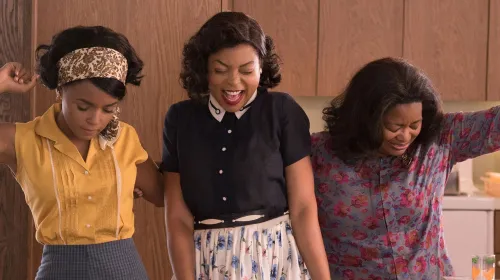
“Yes, they let women do some things at NASA. And it’s not because we wear skirts. It’s because we wear glasses.” #HiddenFigures
On International Women’s Day, we celebrate women and their achievements in shaping families, history, and society. Many courageous women throughout history have attained great accomplishments despite prejudice, discrimination, or abuse, providing strength to the vulnerable and to society alongside their struggle for equality.
These themes of strength and courage are woven through the movie Hidden Figures, inspired by the real-life stories of three Black women—Katherine Johnson, Dorothy Vaughan, and Mary Jackson—notable for their monumental contributions to the NASA Space Program in the 1960s and beyond.
Katherine Johnson, a physicist and research mathematician, is introduced as a gifted child, remarkable for her ability to manipulate numbers in her head. Due to the lack of public schools for Black children in Greenbriar County, her parents moved many miles each year for her to complete high school on the campus of West Virginia State College, where she was subsequently admitted to college at the age of fourteen.
Katherine is portrayed by Taraji P. Henson, who brings the finer points of the script to life, particularly the understated way in which Katherine responds to discrimination. In one recurring sequence, Katherine, on a “temporary” assignment, runs madly through NASA with file folders in hand, trying to reach the “Coloureds Only” bathroom before her extended “breaks” are noticed. It’s maddening to watch her workmates – mostly white men – assume her absence is frivolous, rather than due to the bathroom being a half-mile walk across campus.
In a pivotal scene, painful yet powerful, Katherine finally explodes in response to her supervisor Al Harrison’s (Kevin Costner) ignorance, revealing the daily obstacles she faces. This moment not only expresses her frustration with a system of white privilege but also marks Harrison’s emerging realization of her struggles in a segregated America.
Hidden Figures has faced criticism as a “feel-good” story with composite characters and streamlined dialogue, but many scenes are faithful portrayals of Black women’s experiences in the 1960s. A particularly moving juxtaposition shows real footage of Martin Luther King Jr. alongside Dorothy guiding her children away from a civil rights protest for their safety—illustrating the dual roles of activist and mother that these women balanced.
When Dorothy realizes that her team will be replaced by an IBM computer, she takes initiative, teaching herself and her team programming using a Fortran book she boldly takes from the “white section” of the library. Her foresight leads to her promotion as NASA’s first Black female supervisor—an act of resistance cloaked in resilience.
Mary Jackson, meanwhile, aspires to be an engineer but is denied the required courses under segregation laws. In a powerful courtroom scene, she calmly argues her case to a judge: “I have no choice but to be the first, which I can’t do without you, sir.” She is granted the opportunity to take night classes, breaking another barrier.
The women’s accomplishments are often shown quietly—Katherine is viewed from afar as she calculates trajectories. These scenes highlight her brilliance and growing recognition from her colleagues, especially contrasted with the resentment of Paul Stafford, who denies her credit on reports she co-authored.
The most heart-wrenching moment occurs after Katherine ensures Alan Shepard’s safe orbit, only to be told she is no longer “needed.” She returns to mundane tasks, a bitter reward for her contribution. The scene is subtle but devastating, emphasizing the emotional cost of being marginalized even after monumental achievement.
Katherine’s legacy is cemented when John Glenn famously refuses to launch until “the girl” checks the computer’s math. She, along with Dorothy and Mary, helped shape space history, despite the odds.
As Katherine famously put it: “So yes, they let women do some things at NASA, Mr. Johnson. And it’s not because we wear skirts – it’s because we wear glasses!”
On International Women’s Day, these three remarkable women stand not only as brilliant minds, but as mothers, leaders, and warriors who rose above discrimination. Their stories inspire new generations to pursue dreams and equality, with courage and clarity.